Total Pageviews

Translate

Friday, October 26, 2012

Poem: The Color Blue

The Color Blue
A Masterpiece By Ross
Blue, Blue, O wonderful blue
The color of the sky
The color of the ocean
The color... of blue cheese.

There are so many shades of this wonderful color
There's light blue
Dark blue
The color of jeans (assuming they're blue jeans)

Blue, a powerful color
A primary color
A color that can help make others

What you saw there was Blue
Blue doing what it does best
Blue acting unselfishly
Blue wanting to bring more colors into this world
Blue, just being blue

If you are ever feeling blue
Just remember: blue is feeling you
Its complimenting you on your selflessness
Telling you: while you may not appreciate yourself at the time, others do.

Blue, Blue, O mighty color blue
You always know what to do
You turn me green when I have the flu (best line right there)
You even help me tie my shoe. (rhyme)

Blue...
Blue...
How could I live without you? 

Sunday, October 21, 2012

[President]-isms

This week, during the presidential debate, Mitt Romney delivered a classic. Responding to a question on pay equality for women, Romney said that while assembling his cabinet after being elected governor in Massachusetts, he was not pleased to see that his staff only sent him male applicants. He then proceeded to talk about his response. "I went to a number of women's groups and said, 'Can you help us find folks,' and they brought us whole binders full of women." This binder must have been pretty cramped. 

Romney's gaffe inspired me to search for some occasions in which other U.S. officials have misspoken.

Ronald Reagan on his recent trip: "Well, I learned a lot....I went down to (Latin America) to find out from them and (learn) their views. You'd be surprised. They're all individual countries."

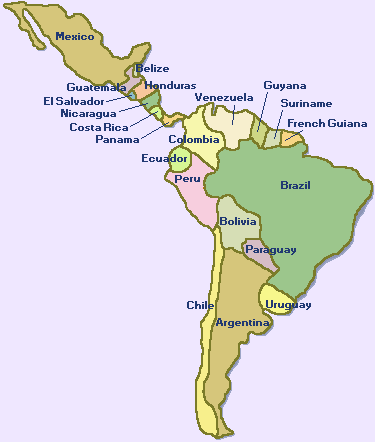
Here's a map of Latin America:
Latin America includes Mexico and all of South America
As I'm guessing you can see, there are multiple countries in this image. What amazes me is that it took Reagan a trip to Latin America to figure that out. And we can't forget that this president was best-known for his foreign policy. I wonder if he thought he was ending a Cold War with all of Asia. 

Here's another one from Mr. Reagan: "Trees cause more pollution than automobiles."


I was going to just let this one speak for itself, but then I found this image describing Reagan's claim:
This tree is breathing out CO2


Here's a quote from Joe Biden, which, at first glance, may not seem too bad. He was introducing Missouri state Senator Chuck Graham: "Stand up, Chuck, let 'em see ya."

The only problem with this is that Graham happens to be in a wheelchair. I will give some props to Biden, however, as he did manage to recover from his blunder and give the man a warm welcoming. Take a look:


Just a little slip up from Joe Biden, nothing too bad. Still, it's quite funny: "The next President of the United States — Barack America!" It's a lot funnier of video:

Last up, one of the best gaffers of all time, Mr. George W. Bush. I'm going to pick a couple of my favorite from a long line of Bushisms.

On the topic of teaching to a test, Mr. Bush goes off, but unfortunately for him, what looked to be his most powerful line, turned out to be a topic of jokes for years to come: "You teach a child to read, and he or her will be able to pass a literacy test."

Clearly having good grammar isn't a requirement to pass literacy tests. Here's a short video compilation of Bush on education (this quote is included):

 
Here's another Bush quote and it's a doozy: "Too many good docs are getting out of the business. Too many OB-GYNs aren't able to practice their love with women all across this country."

I want to say he was trying to refer "love" to the profession, but, well... it came out all wrong.

Friday, October 12, 2012

CAP Debates

The debates started as an interesting assignment but ended up as a real disappointment.

I cannot think of another assignment in which the work I put in could not in any way reflect my result. I'm not sulking about my grade, which wasn't terrible, but I'm frustrated by what high standards we were held to. We spent 30 minutes in NSL class listening to classical music about a river, and that was all the instruction we got on how to debate. Maybe a few minutes of pointers but we got no real practice.

To describe the effort I put in: I worked each minute we were given in class, including through the breaks, and spent most of my Friday after school preparing for the debate. Then I spent several hours on Sunday practicing speaking. I felt there was little more I could do. I clearly do not have a knack for debates, but got little help in school. Now my grade in each CAP class is taking a hit. I find that quite unfair.

I came in with a huge disadvantage, as my group was the first to go. As I watched later debates, I realized several aspects I could have done better, like citing my sources while speaking. Had I presented day two or three, I would have surely made adjustments. So why must I be held to tougher standards?

I'll be the first person to admit that I was far from perfect, but I had never participated in or watched a debate until the presidential one.
 
Last year we had interdisciplinary assignments, which were a nice way once a quarter to take a break from ordinary classes. The work we did was for the most part interesting, and was hardly monitored, much like the debates. The only difference between these two is that last year if one did his or her work and put in effort, an A was easily achievable. It was nice to have one grade in which our effort controlled the result. I expected the debates to be similar, and I was not lacking in effort. So I was left with the question: What could I have done?   

Saturday, September 22, 2012

5x5


Clip 1: Picked up my chemistry textbook.
Clip 2: Flipped to a (random) page.
Clip 3: Started doodling in the textbook.
Clip 4: Used the sky and moved the phone in a circle to represent my eyes drifting all over the place.
Clip 5: Threw my textbook on the ground.

I started my 5x5 by planning out my five shots. Using an iPhone, I first filmed my four shots in the same location. I then went outside to film the last one (Clip 4). Clip 1 was the most difficult to shoot, as I knew that I had to walk over to my textbook, pick it up, and place it on a table within five seconds without seeming rushed. The other four shots were not so difficult, as I only had one task. For the other four clips, I filmed for a minimum of 10 seconds, just in the event that I had a second or two at the beginning where nothing occurred. Out of those four, Clip 4 was the only abnormal one, as there was no particular beginning or end to the clip. So, I just spun in circles until I got dizzy. I then edited the 5x5 on iMovie '06 in just a few minutes. The issue I had was coming up with an idea because everything I that I thought of involved me being in it. I eventually resorted to searching for random objects until I found one that I thought would be a good centerpiece for a film.

I'm pleased with my 5x5, as just 6 hours ago I was sitting around with no inspiration. And by this point I was a little worried, as I had been brainstorming ideas throughout the week. The silent background made me pleased, though a little sound might have been better.

An idea for the next video challenge would be a similar assignment to the 5x5, except that each shot must be in a different location, while still keeping the plot intact. Finding a set is a difficult task in production, and this could help us improve at this aspect.

Thursday, September 20, 2012

1984 Trailer


1984, Michael Radford, R, 1984

1984 is about a man who lives in a totalitarian society, where he, and the rest of the residents, are under constant surveillance by Big Brother. Many do not appreciate his control, leading to an imminent rebellion.

While brainstorming movies with potentially intriguing trailers, I immediately thought of the novel we are reading in class, 1984. Though I had not seen a glimpse of the film until watching the trailer, I expected it to be dramatic, just like the novel and like I'm hoping our trailer will be.

The trailer is an exemplar of what I want to produce, as it focuses mostly on the dystopian setting, with a brief insight into the plot. Little dialogue amongst characters is used to illustrate the setting, and instead the trailer is narrated through characters' lines that serve as voice-overs. Also, we see Big Brother's face countless times. The repetition really helps the viewer understand how controlling this individual is. The viewer sees the main character writing in a journal, clearly against the laws of Big Brother. The most impressive cinematic technique used in the trailer, however, is the music. This dramatic tune runs throughout and it adds to imposing force of Big Brother. For my trailer, I plan on also having a dramatic tune throughout the trailer. I want it also to focus almost entirely on the setting and little on the plot and character development: what makes the society a dystopia. Finally, I don't think dialogue is necessary for a trailer, and a narration from voice-overs seems more appropriate. All of these plans could change while creating our script, but I'm definitely planning on using the 1984 trailer as a model.

Thursday, September 13, 2012

World Without Walls: Learning Well with Others

I read the article "World Without Walls: Learning Well with Others" written by Will Richardson on Edutopia. You can see my annotated page but for some reason there is also stuff highlighted... don't worry about that.

Anyway, onto the actual content. Richardson is attempting to persuade the reader that schools must embrace the advancement in technology. While he states that "face-to-face classrooms... are equally important in a connected world," he also makes it clear that the Internet can come of great use.

I do believe that a teacher is necessary, because, at least for me, learning from a teacher in-person is much easier than trying to search the Web for answers, as there is nothing like the reassurance of having a professional right by my side. My opinion could easily change someday.

He goes on to describe how a middle school class in California connects with one in Canada daily to work on projects together. He downplays some of the negative aspects of working on the Internet, such as the false information.

I'd love to learn script-writing techniques from experts. The creativity is loads of fun, because at this point in the production, there is little guidance. One thing I would need to learn is how to estimate the length of film through the script. Connected learning seems possible, as there are many Blogs out there, and some might pertain exactly to what we are learning. Ideas for films, whether it's the cinematography, the script, the costumes etc. can all be accessed on the Internet. I expect this to prove to be a great resource.

Monday, September 10, 2012

Movie Reviews


Marshall Fine of huffingtonpost.com created a movie review of the film "The Avengers," titled 
"Movie Review: The Avengers." Based on the opening line, "Here's the best thing I can say about The Avengers," I thought this review would be negative. I was completely wrong. Throughout this review, he generally describes the plot and the humor. For the humor, he compares it to other films. He describes the slapstick as "worthy of Chuck Jones in his Looney Tunes heyday." He does not touch on cinematic techniques, which most likely indicates that the purpose of this review was to mostly describe the plot. Judging by the praise Fine gives to the plot and humor, I'm sure he recommends the film.

For the quarterly movie review, I feel as though we should have certain requirements, but be able to focus in-depth on what stoop out to us most during the film. I don't think there should be a basic structure. If people want to write it all in the third-person that should be fine, and if people want to write it from their perspective in the first-person, that should be no problem either.